 Rishi Chemtrade Manufacturer and Supplier Rishi Chemtrade Manufacturer and Supplier Rishi Chemtrade Manufacturer and Supplier Rishi Chemtrade Manufacturer and Supplier Rishi Chemtrade Manufacturer and Supplier
 Rishi Chemtrade is a trusted Poly Aluminium Chloride (PAC) manufacturer and supplier in India, offering premium-quality Poly Aluminium Chloride (PAC) for water treatment, wastewater treatment, and industrial applications. Our PAC is manufactured and sourced under strict quality standards to ensure excellent coagulation performance, high purity, and consistent results.
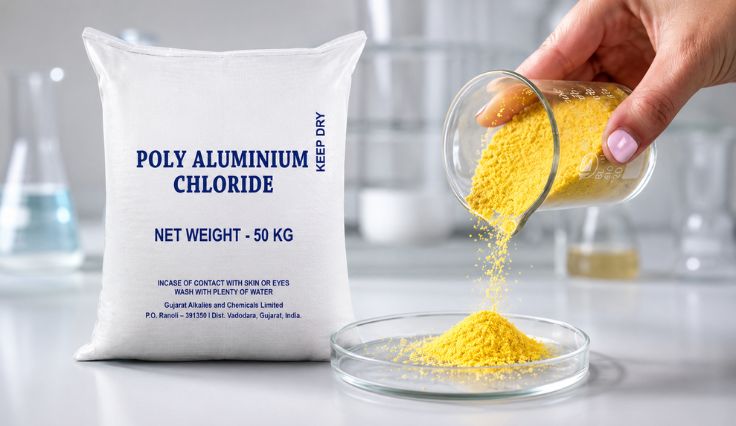
Available in both powder and liquid forms, our product effectively removes suspended particles, organic matter, turbidity, and heavy metals from water. Widely used in municipal water treatment plants, industrial effluent treatment, paper manufacturing, textile processing, and chemical industries, Rishi Chemtrade provides reliable Poly Aluminium Chloride with competitive pricing, customized packaging, and timely delivery across India. Our commitment to quality, technical expertise, and customer satisfaction makes us the preferred partner for industries seeking efficient and cost-effective water treatment solutions.
| Parameter | Specification |
|---|---|
| Product Name | Poly Aluminium Chloride (PAC) |
| Chemical Formula | (Al₂腔H)nCl₆−n |
| Appearance | Yellow to White Powder / Pale Yellow Liquid |
| Form | Powder & Liquid |
| Al₂O₃ Content | 28% – 32% |
| Basicity | 50% – 90% |
| pH (1% Solution) | 3.5 – 5.0 |
| Insoluble Matter | ≤ 1.0% |
| Iron (Fe) | ≤ 0.01% |
| Heavy Metals | ≤ 0.003% |
| Arsenic (As) | ≤ 0.0002% |
| Sulphate | ≤ 3.5% |
| Shelf Life | 6–12 Months |
| Grades Available | Industrial Grade, Drinking Water Grade, Food & Pharma Grade |
| Packaging | 25 kg HDPE Bags, Jumbo Bags, Bulk Packing |
Poly Aluminium Chloride (PAC) is a highly effective coagulant used in drinking water treatment, wastewater treatment, sewage treatment, paper manufacturing, and industrial effluent treatment.
PAC provides faster coagulation, lower sludge generation, improved water clarity, and reduced chemical dosage compared to conventional coagulants.
Rishi Chemtrade supplies high-quality Poly Aluminium Chloride with consistent composition, excellent coagulation efficiency, and reliable industrial supply.
Municipal water treatment plants, industrial wastewater treatment facilities, paper mills, textile industries, and chemical plants extensively use PAC.
Yes. Rishi Chemtrade offers bulk quantities with customized packaging for industrial and municipal customers across India.
PAC should be stored in a cool, dry location using sealed containers to maintain its effectiveness and shelf life.
High-quality PAC improves water purification efficiency, reduces operational costs, minimizes sludge formation, and enhances overall treatment performance, making it a preferred solution for industrial and municipal water treatment.

Our expertise delivers consistent quality, reliable chemical supply, innovative solutions, and exceptional customer support for industries.
 +91-6353302022
 WhatsApp
 Call
Call