 Rishi Chemtrade Manufacturer and Supplier Rishi Chemtrade Manufacturer and Supplier Rishi Chemtrade Manufacturer and Supplier Rishi Chemtrade Manufacturer and Supplier Rishi Chemtrade Manufacturer and Supplier
 Rishi Chemtrade is a trusted Aluminium Nitrate manufacturer and supplier in India, offering premium-quality Aluminium Nitrate (Al(NO₃)₃) for industrial, laboratory, textile, and specialty chemical applications. Our Aluminium Nitrate is manufactured and sourced under stringent quality standards to ensure excellent purity, high solubility, and consistent chemical performance.
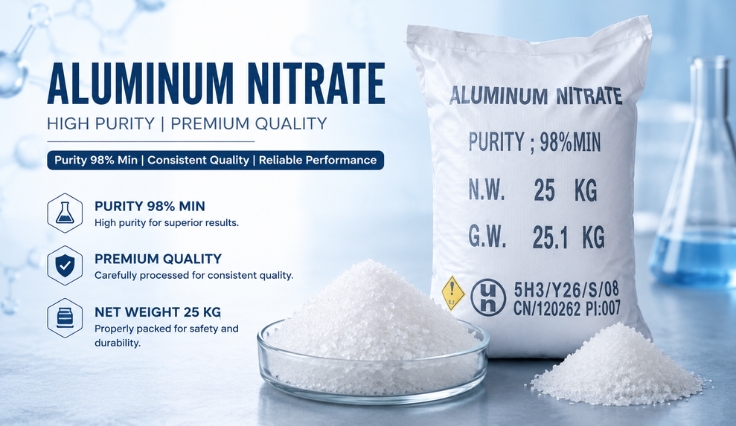
As a reliable source of aluminium and nitrate ions, it is widely used in chemical synthesis, textile dyeing, leather processing, laboratory analysis, catalyst production, and specialty industrial applications. At Rishi Chemtrade, we are committed to delivering high-performance industrial chemicals with competitive pricing, customized packaging, and prompt nationwide delivery. Backed by years of industry expertise and a customer-focused approach, we provide dependable Aluminium Nitrate solutions that meet the highest quality standards across diverse industries.
Our high-quality aluminium Nitrate is widely used in:
| Parameter | Specification |
|---|---|
| Product Name | Aluminium Nitrate |
| Chemical Name | Aluminium Nitrate |
| Chemical Formula | Al(NO₃)₃ |
| Hydrated Form | Al(NO₃)₃·9H₂O |
| Appearance | White or Semi-Transparent Crystals |
| Purity | ≥ 98.5% |
| pH (5% Solution) | 2.5 – 3.5 |
| Solubility | Highly Soluble in Water |
| Density | Approximately 1.72 g/cm³ |
| Chloride | ≤ 0.001% |
| Sulphate | ≤ 0.005% |
| Insoluble Matter | ≤ 0.005% |
| Melting Point | Approximately 73°C |
| Decomposition Temperature | Approximately 135°C |
| Grades Available | Industrial Grade, Analytical Grade, Reagent Grade |
| Packaging | 25 kg HDPE Bags, Drums, Jumbo Bags, Bulk Packing |
Aluminium Nitrate is an inorganic chemical widely used in chemical synthesis, leather tanning, textile dyeing, catalysts, laboratory research, and specialty industrial applications. Rishi Chemtrade supplies high-quality Aluminium Nitrate for industrial use.
It is used in chemical manufacturing, textile processing, leather treatment, catalyst production, laboratory research, and specialty chemical industries.
Rishi Chemtrade offers premium-grade Aluminium Nitrate with high purity, reliable packaging, competitive pricing, and timely delivery.
Yes. Bulk supply is available for industrial manufacturers, distributors, and research organizations.
It should be stored in sealed containers in a dry, cool environment away from moisture and incompatible chemicals.
High-purity Aluminium Nitrate ensures reliable chemical reactions, improved production efficiency, and consistent product quality.
Yes. Rishi Chemtrade supplies Aluminium Nitrate across India with dependable logistics support.

Our expertise delivers consistent quality, reliable chemical supply, innovative solutions, and exceptional customer support for industries.
 +91-6353302022
 WhatsApp
 Call
Call