 Rishi Chemtrade Manufacturer and Supplier Rishi Chemtrade Manufacturer and Supplier Rishi Chemtrade Manufacturer and Supplier Rishi Chemtrade Manufacturer and Supplier Rishi Chemtrade Manufacturer and Supplier
 Rishi Chemtrade is a trusted Potassium Carbonate manufacturer and supplier in India, offering premium-quality Potassium Carbonate (K₂CO₃) for industrial, food, pharmaceutical, and chemical applications. Our product is manufactured and sourced under stringent quality control to ensure high purity, excellent solubility, and consistent performance.
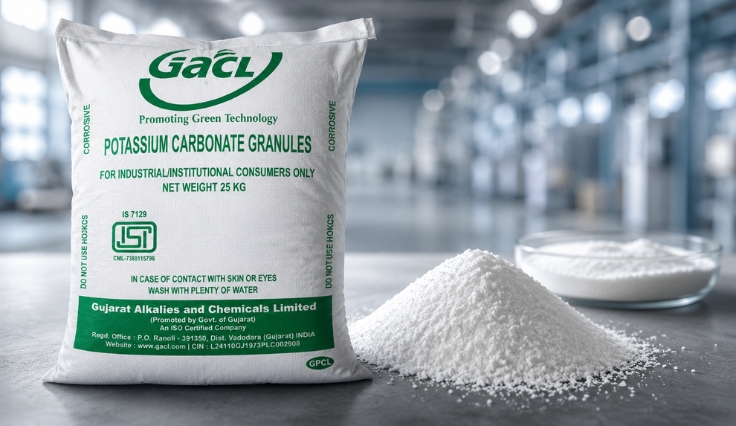
Widely used in glass manufacturing, soap and detergent production, food processing, agriculture, pharmaceuticals, water treatment, and specialty chemical industries, our Potassium Carbonate delivers reliable results in demanding industrial environments. At Rishi Chemtrade, we are committed to supplying superior-quality industrial chemicals with competitive pricing, customized packaging, and prompt nationwide delivery. Our experienced team works closely with customers to provide dependable chemical solutions that improve productivity, support manufacturing processes, and ensure long-term operational efficiency.
| Parameter | Specification |
|---|---|
| Product Name | Potassium Carbonate |
| Chemical Name | Potassium Carbonate |
| Chemical Formula | K₂CO₃ |
| Appearance | White Granular or Powder |
| Assay (K₂CO₃) | ≥ 99.0% |
| K₂O Content | ≥ 68.0% |
| pH (5% Solution) | 11.6 – 12.0 |
| Chloride (Cl⁻) | ≤ 0.01% |
| Sulphate (SO₄²⁻) | ≤ 0.01% |
| Iron (Fe) | ≤ 5 ppm |
| Moisture | ≤ 0.5% |
| Bulk Density | Approximately 1.0 g/cm³ |
| Solubility | Highly Soluble in Water |
| Grades Available | Industrial, Food & Pharmaceutical Grade |
| Packaging | 25 kg HDPE Bags, Jumbo Bags, Bulk Packing |
Potassium Carbonate is an alkaline inorganic compound used in fertilizers, specialty glass, detergents, chemicals, pharmaceuticals, and food processing.
It is widely used in glass manufacturing, fertilizer production, specialty chemicals, detergents, pharmaceuticals, and food industries.
Rishi Chemtrade supplies premium-grade Potassium Carbonate with reliable quality, competitive prices, and prompt nationwide delivery.
Yes. Industrial bulk quantities are available for manufacturers and distributors.
It offers excellent alkalinity, consistent chemical performance, and improved manufacturing efficiency.
It should be stored in airtight containers away from moisture and direct sunlight.
Glass, fertilizer, pharmaceutical, detergent, food processing, and specialty chemical manufacturers regularly use Potassium Carbonate.

Our expertise delivers consistent quality, reliable chemical supply, innovative solutions, and exceptional customer support for industries.
 +91-6353302022
 WhatsApp
 Call
Call